Naturism in the United States: laws and customs
Updated October 25, 2026
In the United States nudity laws vary from state to state, and naturism lives mainly in private clubs and resorts. Legal beaches are few; elsewhere you risk being charged.
At a glance
- Official naturist beaches and areasA few (Haulover, Hippie Hollow, Gunnison, Collins Beach): allowed there
- Naturist staysPrivate clubs and resorts: allowed
- Unofficial naturist beachesDepends on the state: often tolerated, charges if someone complains
- Naked in nature, away from peopleDepends on the state: a crime in some, in others only if obscene
- Regular beach, townDepends on the state: usually a minor offence (misdemeanor)
- Local bansNot verified: county and city ordinances not read
- ToplessDepends on the state: an offence in some (e.g. Arizona, Indiana); rare and frowned upon
- Sauna without swimwearDivided: acceptable for 46%, not for 40%
- LGBTQ+ travellersNo offences linked to orientation
A country more modest than Europe, which accepts naturism within its own enclosure: private clubs and a few designated beaches.
What the law says
In the United States there is no federal law on nudity: criminal law belongs to the individual states, and then there are counties, cities and federal lands. The laws vary widely. Almost everywhere indecent exposure is a minor offence (misdemeanor), but there are severe exceptions, such as Oklahoma (see below).
A charge can be costly. In many states penalties rise sharply if the exposure happens in front of minors (among others Arizona, Washington, Pennsylvania, Kansas, Minnesota, Nevada, Indiana, North Carolina). According to FindLaw, in several states a conviction for "indecent exposure" can lead to registration as a sex offender (FindLaw); we have not verified which ones. In Hawaii the Supreme Court has ruled it out.
National parks: there is no federal rule banning nudity in all parks; only Cape Cod has one. The park service does not designate nude areas and, if there are problems, it applies the disorderly conduct rules first, then state law (National Park Service). On federal lands, therefore, the laws of the state they are in apply.
Private spaces: some states also punish nudity on your own property, if it can be seen from someone else's property or from the street: Florida, North Carolina, Indiana, New York. In Oregon only if there is sexual intent.
State by state
The venues in our list are in 32 states, mainly Florida, Texas and California. Reading only the text of the laws (not the case law), the states fall into two groups.
Only obscene or sexually motivated exposure is punished. Simple nudity, without that element, is not covered by the text:
- Texas: exposing the anus or genitals with intent to arouse someone; Class B misdemeanor (text).
- California: exposing private parts "willfully and lewdly"; misdemeanor (text). But in state parks nudity is banned outside authorised areas.
- Oklahoma: here too the exposure has to be "lewd", but it is a felony: a fine of $500 to $20,000 and/or 30 days to 10 years in prison (text).
- Similar wording in Oregon, Illinois, Minnesota, Connecticut, Kansas, Rhode Island (up to 1 year or $1,000), Washington, Virginia, Georgia and New Jersey.
Exposure that may offend or alarm is punished, even without sexual intent:
- Florida: it is prohibited to be naked in public "in a vulgar or indecent manner"; first-degree misdemeanor. Simply being naked in a place provided for that purpose is not an offence (text).
- Pennsylvania: exposing your genitals knowing it is likely to offend someone; second-degree misdemeanor (text).
- Indiana: punishes public nudity in itself (Class C misdemeanor), more serious in schools and public parks; for women the nipple also counts.
- Michigan: "open or indecent exposure", up to 1 year or $1,000 (text).
- Arizona: genitals, anus and, for women, areola or nipple, if someone present could be offended; Class 1 misdemeanor (text).
- North Carolina: exposing yourself in front of others is prohibited, except in designated places; Class 2 misdemeanor (text).
- Tennessee: state-licensed "clothing optional" family venues do not count as a public place.
- Nevada: gross misdemeanor the first time; felony for repeat offenders or if an adult does it in front of a minor (text).
- Hawaii: petty misdemeanor; according to a 2000 ruling there is no offence if the other bather was also naked (text).
- New York: appearing in public with your private parts uncovered is only a "violation", not a crime (text).
- South Carolina up to 3 years (text), Maryland up to 3 years or $1,000 (text), Colorado petty offense. Similar wording in Ohio, Missouri, West Virginia (up to 90 days or $250), Wisconsin, Massachusetts (up to 6 months or $200) and Alabama.
Where you can be naked
- Legal beaches: there are few.
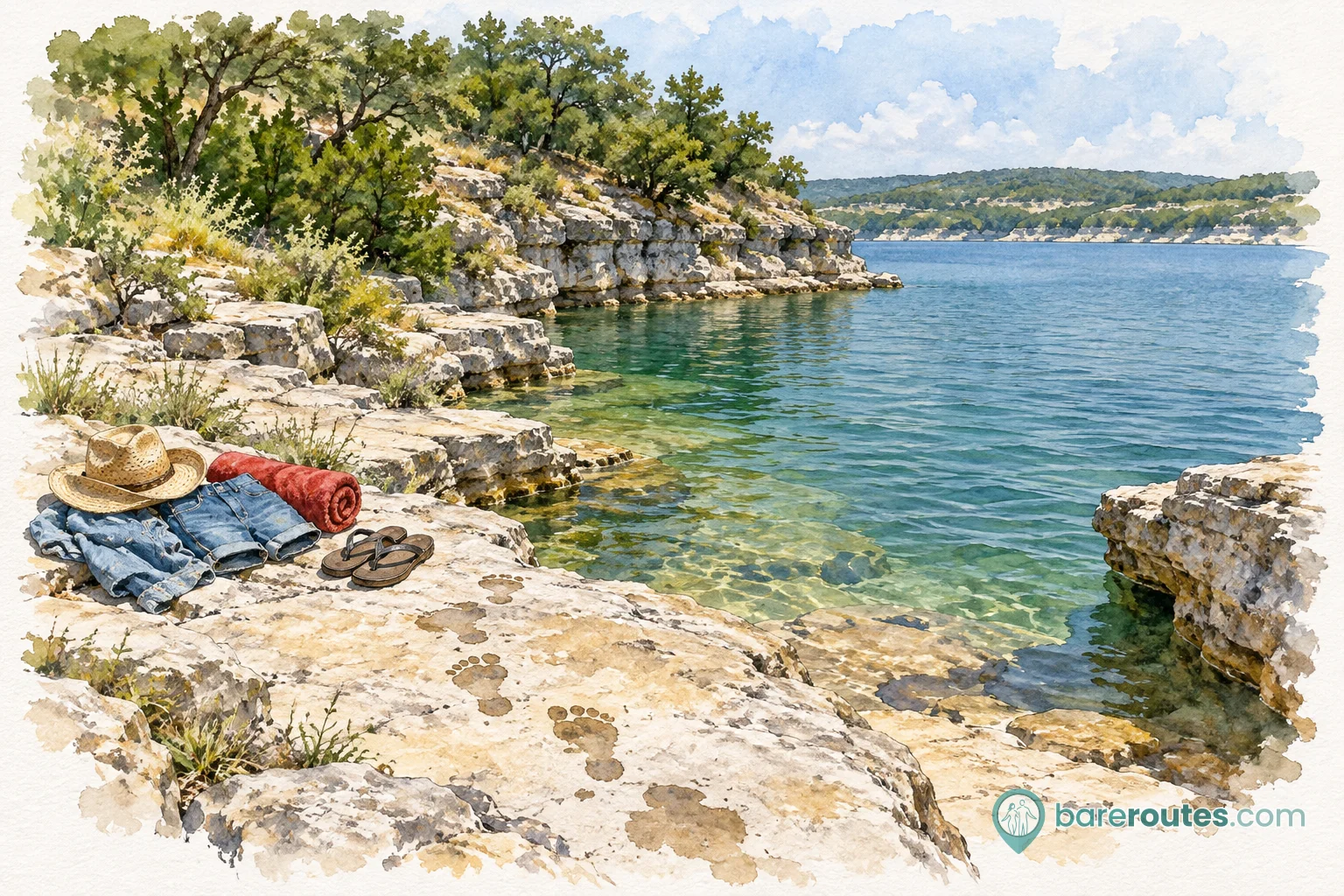
- Hippie Hollow, on Lake Travis (Texas): "the only clothing optional public park in Texas", adults only; "Nudity is acceptable, lewd behavior is not" (Travis County Parks).
- Haulover Beach (Miami-Dade, Florida): the northern stretch has been clothing optional for over 30 years, defended by the county against the state (Miami Herald).
- Gunnison Beach (Sandy Hook, New Jersey), in a federal park: the park service lists it as clothing optional (NPS).
- Collins Beach (Sauvie Island, Oregon): clothing optional within signposted boundaries (ODFW).
- Naturist stays: real naturism is mainly practised in private clubs and resorts. Almost all the American venues in our list are of this kind: you'll find them in the list of naturist stays in the United States.
Tolerated beaches and bans
Many beaches are used by nudists without being legal. The best-known case is Black's Beach in San Diego: in 1974 it became the first clothing-optional beach recognised by an American city, then it was banned. Today nudists are there openly, there are no signs, and enforcement is "very rare" according to locals (Los Angeles Times). In Hawaii, in 2021, the state temporarily closed Little Beach (Maui) over Sunday parties with nudity, alcohol and crowds (DLNR Hawaii).
According to American naturists, these beaches grew up in secluded places where the police didn't step in if nobody complained. Today phone photos and online complaints have got some of them closed, such as Lighthouse Beach on Fire Island (New York). On the most famous legal beaches, such as Haulover and Gunnison, several visitors complain about men who harass people, especially women (Reddit).
We have not read the county and city ordinances, which can add bans.
Topless, towns and saunas
- Topless: in several states the law explicitly covers the female breast (Arizona, Indiana, California state parks; in New York as a mere "violation"). In Colorado, in 2019, a federal court of appeals upheld the suspension of Fort Collins' ban, which prohibited bare breasts for women but not for men (Justia). Women going topless on a public beach is acceptable to only 27% of Americans (17% of women), and 5% of women have done it.
- In town: the state laws above apply.
- Sauna: 46% of Americans find being naked in a sauna acceptable, 40% don't; 18% have done it.
The local mood
Americans are more modest than Europeans and accept naturism "within its own enclosure": private clubs and a few designated beaches. Nudity is acceptable on a nude beach for 79%, but on any ordinary beach for only 8% (YouGov, 2025). Religion also carries more weight than in almost all of Western Europe (Pew Research Center).
Laws are often strict on paper and vary from state to state. In secluded places that have been used for a long time, the police usually step in only if someone complains; where there are families or tourists, the risk goes up.
Naturist associations
- AANR, American Association for Nude Recreation: the national association, with regional sections and a list of affiliated clubs.
- The American federation that belongs to the INF-FNI, the international federation, is based in Nevada (INF-FNI).
LGBTQ+ travellers
Same-sex relations are legal throughout the country and for travellers there are no offences linked to orientation. ILGA does, however, report limits on freedom of expression that vary from state to state (ILGA).
This guide sums up laws and customs as we checked them on the date shown, citing the sources. It is not legal advice: rules can change.